
📰 Written By: Frank….
Square Enix has started its new financial year strongly, with operating income almost doubling year-on-year. After years of restructuring, a greater push towards multiplatform releases and changes to how it develops its games, are we beginning to see signs of a healthier Square Enix?
Square Enix has reported an impressive start to its latest financial year.
For the three months ending June 30, 2026, the company recorded ¥78.4 billion in net sales, compared with ¥59.2 billion during the same period last year.
More significantly, operating income increased from approximately ¥9 billion to ¥17 billion – an increase of 88.6% year-on-year.
Profit attributable to owners of the parent also climbed from approximately ¥4.8 billion to ¥13.2 billion.
Those are substantial improvements.
And for gamers, the most interesting part of the results is where much of that growth came from.
Square Enix says increased sales and operating income were driven by stronger performance from its Digital Entertainment business.
Square Enix’s gaming business had a very strong quarter
Digital Entertainment – which encompasses Square Enix’s HD games, MMOs and smart-device/PC browser games – generated approximately ¥49.9 billion in sales, up from ¥32.9 billion a year earlier.
Operating income increased from ¥8.1 billion to approximately ¥15.5 billion.
That’s growth across all three major areas of Square Enix’s gaming operation rather than one runaway product carrying the entire business.
Its traditional HD Games business was particularly strong.
Net sales almost doubled from ¥8.9 billion to ¥17.7 billion, while operating income increased dramatically from ¥1 billion to ¥6.1 billion.
Square Enix attributes that improvement to stronger sales from both new releases and catalogue titles.
And that’s where things become particularly interesting.
Is Square Enix’s multiplatform strategy beginning to work?
Square Enix has spent the past few years changing the way it approaches the games business.
One of the biggest changes has been its move towards a broader multiplatform strategy.
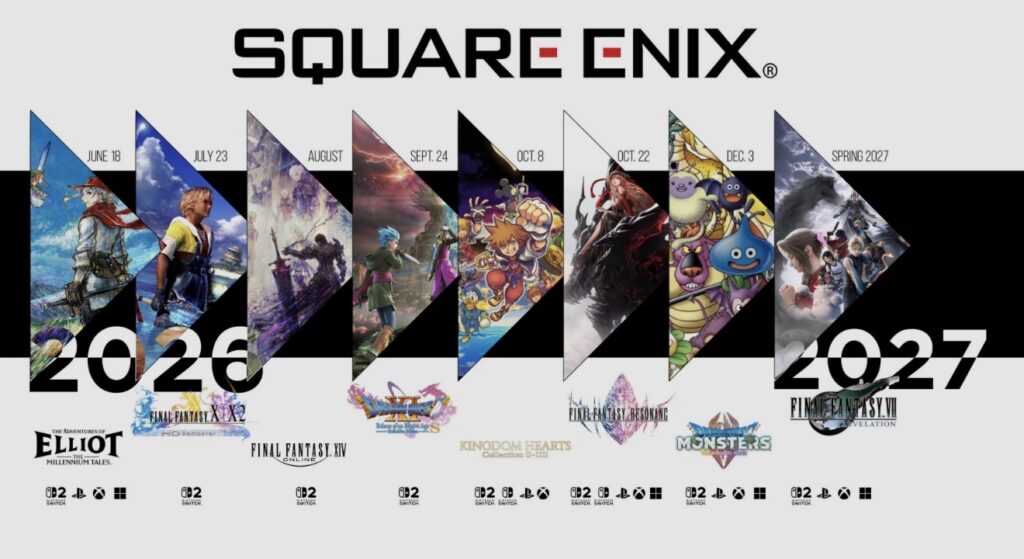
Rather than relying as heavily on individual platforms for major releases, Square Enix wants its games to reach considerably larger audiences across PlayStation, Xbox, Nintendo and PC where appropriate.
From our perspective, that strategy makes sense.
Modern AAA games are enormously expensive to produce. If you’ve spent years and potentially tens of millions developing a game, deliberately limiting the number of people who can buy it becomes increasingly difficult to justify unless an exclusivity agreement adequately compensates for that smaller audience.
But there’s an important distinction here.
We cannot say Square Enix’s multiplatform strategy caused this 88.6% increase.
The company’s financial results don’t establish that.
Square Enix itself says the improvement was driven by stronger performance across HD Games, MMOs and smart-device/PC browser games.
What we can say is that Square Enix is broadening the availability of its games at the same time that its gaming business is showing significant improvement.
Whether those two developments eventually prove directly connected will require more than one quarter of financial results.
Final Fantasy XIV continues to deliver

Square Enix’s MMO business also grew.
Revenue increased from ¥9.6 billion to ¥12.7 billion.
The company says improved player activity following the announcement of Final Fantasy XIV’s next expansion contributed to that increase.
Interestingly, the additional revenue didn’t translate into a similar increase in profit.
MMO operating income remained at roughly ¥3.6 billion, with Square Enix explaining that upfront costs associated with the upcoming expansion limited profit growth.
That’s a useful reminder of how game-development economics actually work.
Growing revenue doesn’t automatically mean dramatically growing profit — particularly when money is simultaneously being invested into future content.
Mobile and browser games grew too
Square Enix’s smart-device and PC browser business also improved considerably.
Sales increased from ¥14.3 billion to ¥19.4 billion, while operating income rose from ¥3.3 billion to ¥5.7 billion.
Square Enix says new titles released since the equivalent quarter last year contributed to the improvement.
So again, we’re not looking at one successful game distorting Square Enix’s results.
All three major parts of its Digital Entertainment division grew.
And that’s arguably more encouraging than one blockbuster release producing a temporary spike.
90% of Square Enix’s game sales were digital
There’s another figure buried in Square Enix’s presentation that deserves attention.
During the quarter, Square Enix sold approximately 7.38 million units across its HD Games and MMO businesses.
Of those:
6.65 million were downloads.
Only 730,000 were packaged copies.
That means approximately 90% of those unit sales were digital.
That’s an extraordinary figure when you consider Square Enix’s history as one of the major publishers of physical console games.
There is an important qualification.
These figures cover titles within Square Enix’s HD Games and MMO segments, including titles it distributes. They should therefore not be interpreted as saying “90% of everything Square Enix sells is digital.”
Nevertheless, the direction of travel is difficult to ignore.
For every packaged game represented in these quarterly figures, Square Enix sold roughly nine digitally.
Given the ongoing debate surrounding the future of physical gaming, that’s worth paying attention to.
Does success give Square Enix more room to take risks?
There’s another question we think is worth asking.
We’ve recently discussed whether the AAA games industry has become increasingly afraid of taking creative risks.
One reason for that caution is obvious.
Games are expensive.
When companies are investing enormous amounts of money into development, executives naturally want projects capable of producing predictable returns.
But stronger financial performance potentially gives publishers something valuable:
Room to experiment.
Square Enix possesses some of the most recognisable franchises in gaming.
Final Fantasy.
Dragon Quest.
Kingdom Hearts.
But we’d also like to see a successful Square Enix continue investing in new ideas.
Not every game needs to become the next Final Fantasy.
Not every project needs a gigantic AAA budget.
Some of gaming’s most interesting ideas currently come from smaller teams precisely because they’re willing to experiment.
If Square Enix’s changing strategy creates a healthier company, we’d like to see some of that success reinvested into developers being allowed to take those chances.
But one quarter doesn’t prove anything
This is where we need to temper the excitement.
We’re talking about three months of financial performance.
Square Enix itself hasn’t suddenly declared its transformation complete.
In fact, despite this strong opening quarter, the company has left its full-year forecasts essentially unchanged.
Square Enix continues to forecast approximately ¥298 billion in net sales and ¥49 billion in operating income for the financial year ending March 2027.
That’s significant.
Management clearly isn’t assuming that an exceptional first quarter will simply continue at the same rate for the rest of the year.
And neither should we.
Gaming companies can have dramatically different quarters depending on release schedules, development expenditure and the performance of individual titles.
We’ll need several more reporting periods before we can say with confidence that Square Enix’s wider transformation has succeeded.
WildStarGaming’s View
There’s plenty here for Square Enix to be pleased about.
Operating income rising 88.6% is significant.
Digital Entertainment is growing.
HD Games performed strongly.
MMO revenue increased.
Its mobile and browser operation grew.
And Square Enix is increasingly putting its games in front of wider audiences.
But we don’t think the conclusion should be:

“Multiplatform fixed Square Enix.”
The evidence doesn’t support that yet.
What we’re seeing instead is something more interesting.
Several parts of Square Enix’s business are improving at the same time the company is undergoing one of the biggest strategic transformations in its recent history.
That’s encouraging.
Now Square Enix has to prove it can maintain that momentum.
And if it can, we’d like to see the benefits go beyond the balance sheet.
More players getting access to Square Enix games is good.
A financially healthier Square Enix is good.
But perhaps the most exciting outcome would be a Square Enix confident enough to let its developers take a few more risks.
Because ultimately, stronger numbers only matter to gamers if they eventually help produce better games.
Contact us on our social media and don’t forget to listen to our podcast.